Regrouping trips up more students than almost any other early math skill. One minute a child is confidently adding two-digit numbers, and the next minute a problem like 47 + 38 shows up — suddenly there’s a “1” that needs to be carried, and everything falls apart. The good news? With the right addition and subtraction with regrouping games online, that confusion turns into confidence a lot faster than worksheets alone can manage.
This page is home to a free, browser-based vertical math game built specifically to help kids (and anyone brushing up on the basics) practice carrying and borrowing in a format that mirrors exactly what they see on paper — but with instant feedback, a live scoreboard, and just enough game-like pressure to keep things fun.
What Is “Regrouping” in Addition and Subtraction?
Regrouping is the process of exchanging value between place-value columns when a digit doesn’t fit on its own:
- In addition (carrying): when the digits in a column add up to 10 or more, you “carry” the extra ten into the next column.
- In subtraction (borrowing): when the top digit in a column is smaller than the bottom digit, you “borrow” a ten from the column to its left.
It’s a deceptively simple idea that trips up a huge number of students because it requires holding two operations in your head at once: the column math and the exchange between columns. That’s exactly why dedicated practice — ideally interactive practice — makes such a big difference.
Why Play Regrouping Games Online Instead of Just Using Worksheets?
Paper worksheets aren’t going away, and they’re a fine supplement. But an online addition and subtraction game has a few advantages that are hard to replicate with pencil and paper:
- Instant feedback. The moment an answer is typed in, the game shows whether each digit is right or wrong, so mistakes get corrected before they turn into bad habits.
- Unlimited, randomized practice. Every round generates a brand-new problem, so there’s no running out of practice material and no memorizing answers from a printed answer key.
- Visible carry and borrow boxes. The game can display the exact spot where a digit needs to be carried or borrowed, reinforcing the physical habit of writing it down — the same habit teachers look for on paper tests.
- Built-in motivation. A timer, a running score, and a question counter turn repetitive drilling into something that feels more like a challenge than a chore.
Inside This Regrouping Practice Game
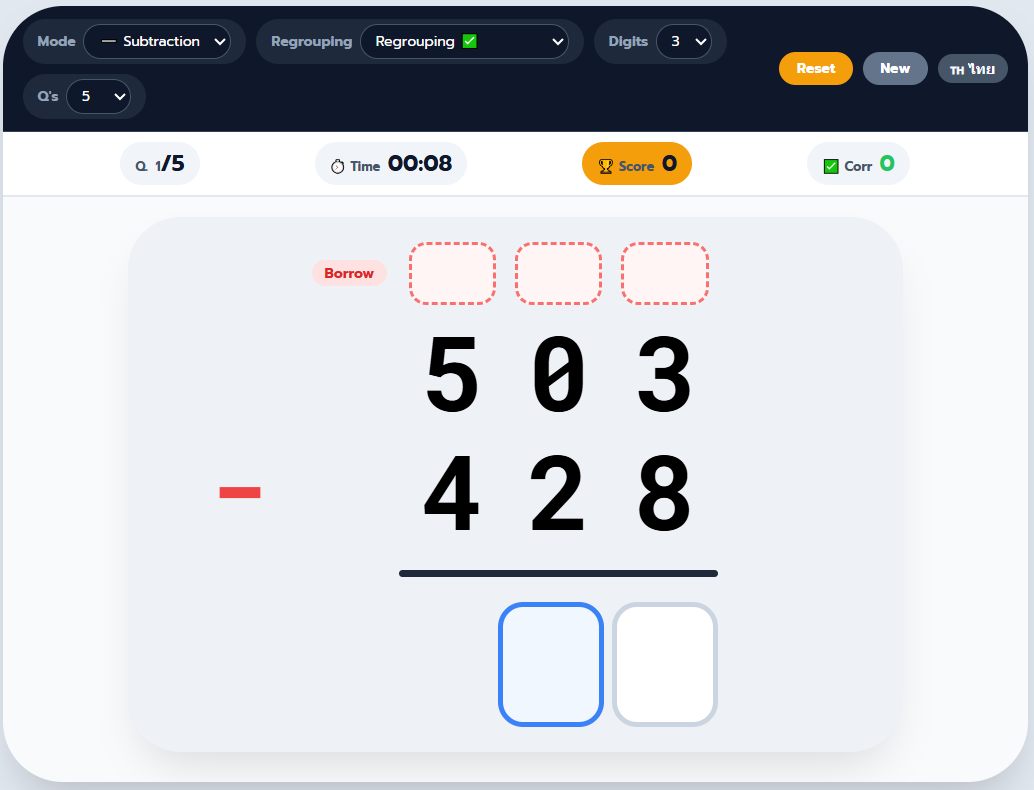
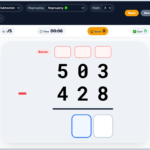
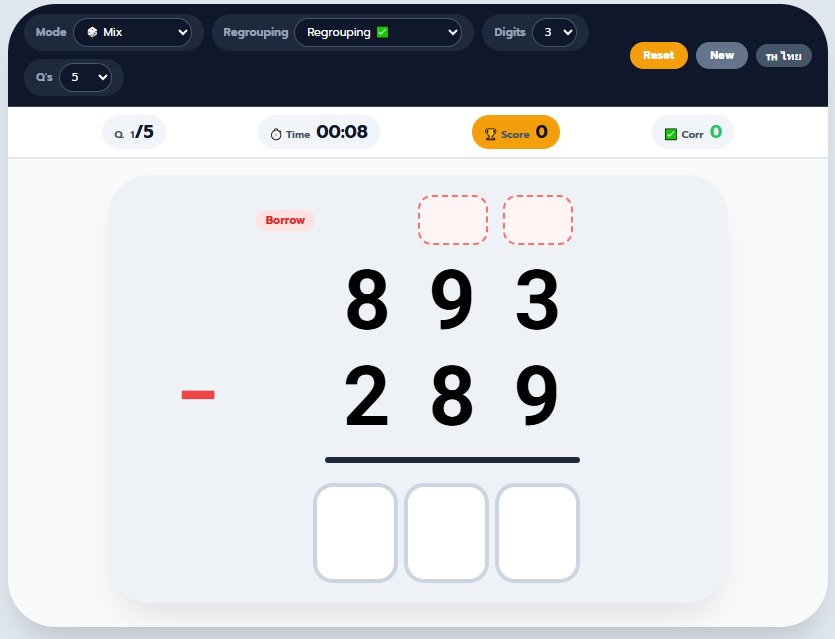
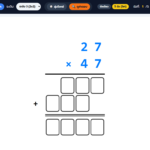
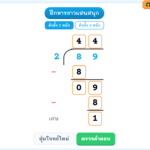
This particular game keeps the visual layout as close as possible to how addition and subtraction are taught in the classroom — stacked vertically, with the operation symbol on the left and a line underneath, just like on paper.
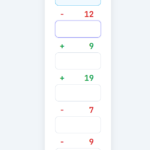
Vertical problem format. Numbers stack directly on top of each other in large, easy-to-read digits, with addition shown in blue and subtraction in red, so the operation is always obvious at a glance.
Digit-by-digit answer input. Instead of typing a whole number into one box, players enter one digit per column, with the cursor auto-advancing to the next box. This mirrors how regrouping is actually solved and makes it much easier to spot exactly which digit went wrong.
Optional carry and borrow boxes. A dedicated row above the problem lets players write in the “carry” or “borrow” digit for any column that needs it — the same scratch-work a teacher would ask to see. This can be toggled on or off depending on whether a student is just learning the concept or is ready to solve without the visual scaffolding.
Adjustable difficulty. Four settings let the game scale from a beginner’s first regrouping problems all the way up to a real challenge:
- Mode: choose addition only, subtraction only, or a mixed set of both.
- Digits: control how many digits are in each number, increasing the difficulty as skills improve.
- Number of questions: set how many problems make up a session, from a quick warm-up to a longer practice set.
- Regrouping toggle: practice problems that specifically require carrying or borrowing, or stick to problems that don’t, depending on what a student needs to work on.
Live scoring and a timer. A running clock and a score that rewards both accuracy and speed keep the pace up, and a results screen at the end sums up correct answers, time used, and difficulty level — useful for tracking progress over multiple sessions.
Two languages. The interface can switch between English and Thai with a single click, making it accessible to a wider range of learners and classrooms.
How to Play
- Pick an operation mode — addition, subtraction, or a mix of both.
- Choose how many digits each number should have and how many questions you want in the round.
- Decide whether to turn regrouping practice on or off.
- Solve each problem one digit at a time, filling in any carry or borrow boxes if they’re shown.
- Watch the instant color feedback, check your score and time at the end, and hit play again to try a harder level.
Who Benefits From Regrouping Practice Games
- Elementary students working through addition and subtraction with regrouping for the first time, who need lots of low-stakes repetition to build fluency.
- Parents looking for a quick, screen-time-friendly way to reinforce what’s being taught in class, without printing out stacks of worksheets.
- Teachers and tutors who want a quick warm-up activity, a way to differentiate difficulty across a classroom, or informal proof of how a student is progressing.
- Older students or adults who simply want to sharpen basic mental math and arithmetic speed.
Tips for Mastering Carrying and Borrowing
- Start without regrouping. Get comfortable with the vertical format and digit-by-digit answers before turning regrouping on.
- Always write the carry or borrow digit down. Skipping this step is one of the most common sources of careless mistakes — the game’s carry/borrow boxes exist for exactly this reason.
- Increase digits gradually. Move from two-digit to three-digit problems only once accuracy is consistently high, not just when speed feels good.
- Mix addition and subtraction. Once each operation feels solid on its own, switching to mixed mode forces faster recognition of which rule applies.
- Track your score over time. Use the timer and score from each session as a simple benchmark, and aim to beat your previous best rather than chasing speed alone.
Frequently Asked Questions
What age is this regrouping game appropriate for? It works well for students who have already been introduced to two- and three-digit addition and subtraction, typically around grades 2–4, though the adjustable difficulty makes it flexible for younger beginners and older students who need a refresher.
Do I need to download anything to play? No. The game runs directly in a web browser, so there’s nothing to install and it works on both desktop and mobile devices.
Can I practice subtraction with borrowing only, without addition? Yes. The mode selector lets you choose subtraction only, addition only, or a mixed set of both.
What if a problem doesn’t need regrouping even though the setting is turned on? The game specifically generates problems that require carrying or borrowing when the regrouping setting is switched on, so every problem in that mode gives real regrouping practice rather than random luck.
Is this game free to play? Yes, it’s completely free with no account or sign-up required — just choose your settings and start playing.
Ready to Practice? >>> PLAY GAME
Regrouping is one of those math skills that clicks with repetition, and the fastest way to get that repetition in is through addition and subtraction with regrouping games online that give immediate feedback and keep the difficulty right where it needs to be. Scroll up, choose your settings, and start your first round — the more you play, the more automatic carrying and borrowing will become.
Ready to Practice?



Leave a Reply