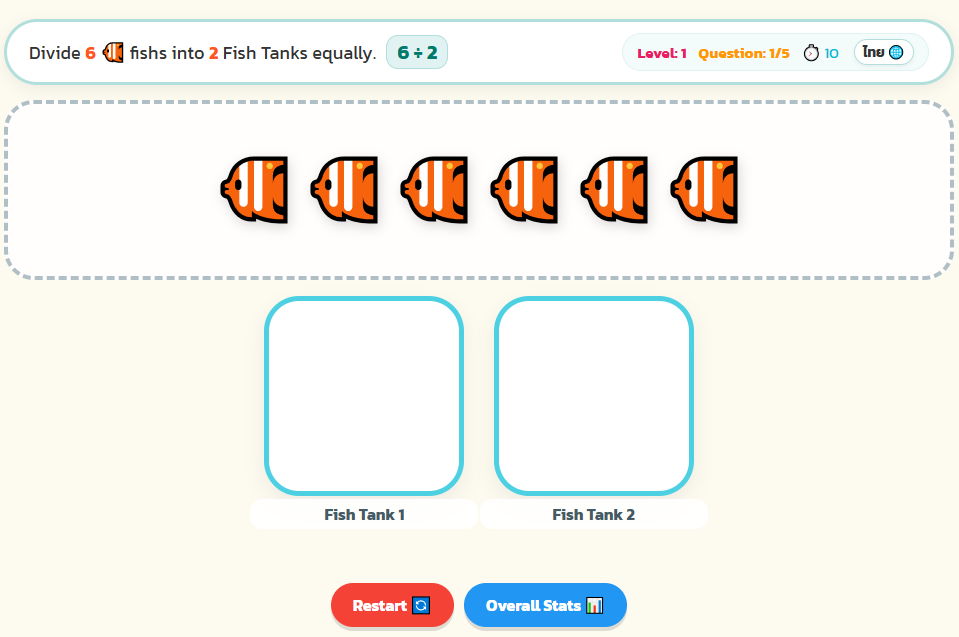
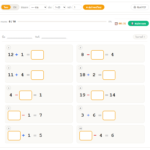
Division is one of those topics that looks simple on a worksheet — “12 ÷ 3 = 4” — but means very little to a child who hasn’t yet connected that symbol to something real. Math Adventure: 12 Themes is a drag and drop math game built around a simple idea: instead of asking a child to calculate a division problem, hand them the objects and let them divide.
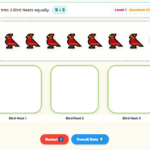
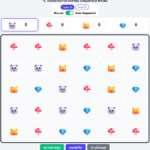
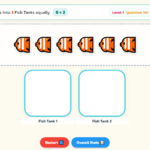
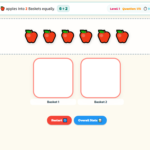
Every round drops a pile of icons into a dashed source area — apples, monkeys, cars, donuts, cats, balls, rockets, bees, gems, pizza slices, birds, or fish, chosen at random from twelve rotating themes. Below that sit a row of empty boxes: baskets, cages, garages, cat houses, whatever fits the theme. The child’s job is to drag the right number of items into each box so every group ends up equal.
How the Drag and Drop Actually Works
The interaction is built for more than one style of play. A child can tap items one at a time to select them, or click-and-drag a selection rectangle across the source area to grab a whole cluster at once, then drag the group into a box in a single motion. On tablets, the same gestures are rebuilt with touch events so dragging feels native on an iPad rather than borrowed from a desktop interface.
The feedback is immediate and visual rather than a delayed right/wrong verdict. Drop too many items in a box and its border flashes red with a message showing exactly how many are over. Drop too few and it flashes orange. Only when every box holds the exact right number does the whole board glow green and confetti fires across the screen — a small payoff, but enough to make a five-year-old want to do it again.
Why Equal Sharing Is How Division Should Be Taught First
This structure isn’t decorative. Splitting a set of physical objects into equal groups is the concrete stage of the concrete-pictorial-abstract progression that Singapore Math methodology is built on — division is introduced as sharing before it’s ever introduced as a symbol. A child who has physically distributed 8 apples into 2 baskets and counted 4 in each has already done the division; the equation “8 ÷ 2 = 4” is just a label for something they’ve already understood with their hands.
Example problem: the game presents “Divide 6 apples into 2 baskets equally.” The child drags apples across until each basket holds 3. Only after the boxes are correct does the badge above the task update to show 6 ÷ 2 = 3 — the abstract notation arrives after the physical action, not before it.
Teaching Remainders the Same Concrete Way
Roughly half the questions in each level are marked as bonus challenges, and these introduce remainders using the exact same mechanic. Instead of dividing everything evenly, a few items are meant to be left over in the source area.
Example problem: “Divide 10 gems into 3 treasure boxes equally — how many are left over?” A child who fills each box with 3 gems will find 1 gem left in the source container. That leftover gem isn’t an error to fix — it’s the correct answer. The game checks that the source area holds exactly the expected remainder before marking the round correct, which means “remainder” stops being an abstract exception rule and becomes something the child can literally see sitting outside the boxes.
Levels, Difficulty, and Built-In Progress Tracking
Each level runs five questions before a summary screen appears. The very first two questions always use two boxes to keep the entry point gentle; after that, the game randomizes between two and three boxes and two or three items per box, so the numbers involved stay small and age-appropriate while the group count and remainder possibilities vary. Scoring rewards both accuracy and speed — base points per question, a bonus for solving remainder challenges, and extra points for finishing quickly — and a running report tracks total questions solved, bonus challenges found, total time spent, and average speed per question. For a teacher or parent watching over a child’s shoulder, that end-of-level summary is a quick, honest read on where a child’s division fluency actually stands, not just whether they got the last answer right.
Built to Work the Way Thai-English Classrooms Actually Do
The entire interface — instructions, level labels, button text, even the remainder wording — toggles between Thai and English with a single tap, mid-session, without losing progress. That matters for classrooms and households where a lesson might be introduced in one language and reinforced in the other, and it’s why the game was built bilingual from the ground up rather than translated after the fact.
The layout itself is tuned specifically for tablets: the screen locks so nothing scrolls or jitters mid-drag, item sizes scale to the viewport instead of using fixed pixel values, and dragging is rebuilt on touch events rather than relying on desktop drag-and-drop behavior working “well enough” on a touchscreen.
Twelve themes means a child rarely sees the same visual setup twice in a row, which keeps a repetitive skill — equal division, over and over — from feeling repetitive. The math underneath stays exactly as rigorous either way: every session is still division, still remainders, still a child doing the arithmetic themselves one dragged icon at a time.

Leave a Reply