Division Games for Kids: How “Math Adventure” Turns Sharing Into a Skill Kids Actually Understand
Division is the math skill most likely to trip up early learners, not because the arithmetic is hard, but because the idea is abstract. Telling a six-year-old that “12 ÷ 3 = 4” means almost nothing until they’ve physically split a pile of things into equal groups and seen what’s left over. That’s the gap Math Adventure, a drag-and-drop division game, is built to close — and it does it with a level of design detail that’s worth walking through if you’re looking for division games for kids that go beyond flashcards.
Learning Division by Sharing, Not Memorizing
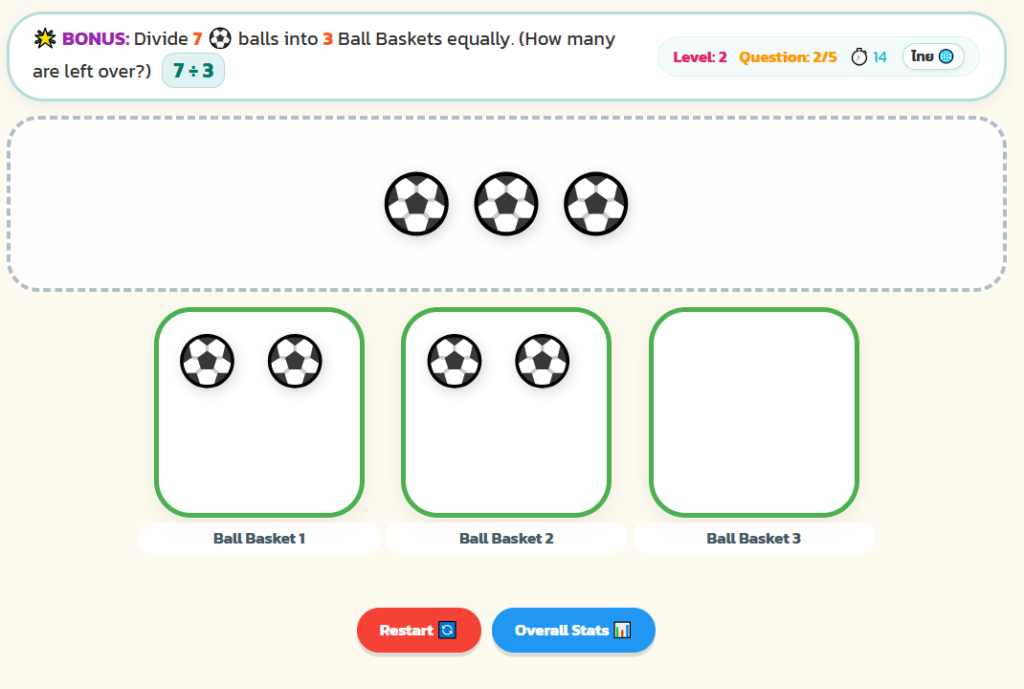
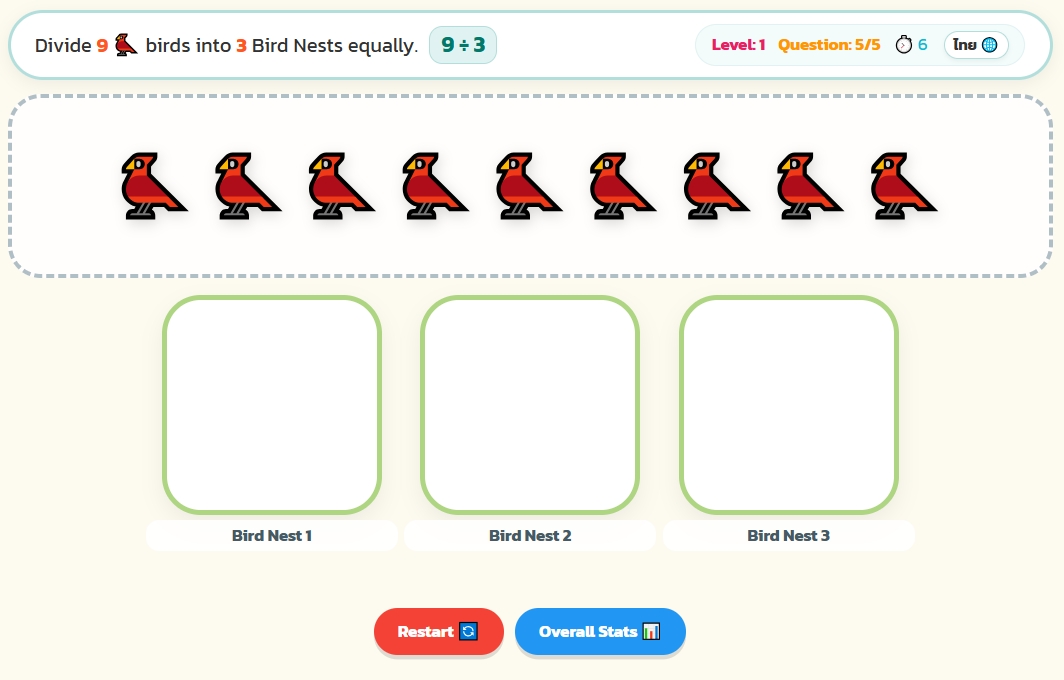
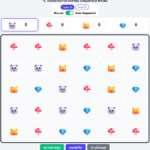
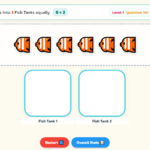
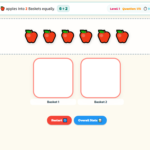
Instead of presenting a division sentence and asking for an answer, the game hands kids a pile of emoji items — apples, monkeys, donuts, rockets, gems, and eight other rotating themes — and a set of empty containers: baskets, cages, plates, garages. The task is always the same shape: “Divide 10 apples into 3 baskets equally.” Kids drag items one at a time, or select several at once with a tap-to-select or click-and-drag selection box, and drop them into the containers.
This is partitive division in its purest form — the “fair sharing” model that most curricula, including Singapore Math, use to introduce the concept before moving to abstract notation. Because the child is doing the distributing themselves, the idea that division means equal groups becomes something they’ve done with their hands, not something they were told.
Real-Time Feedback Instead of Right/Wrong Answers
What sets the interaction apart is how it checks the child’s work. Every time an item is dropped, the game re-evaluates all the containers instantly:
- A box with too many items gets a red glow and shows exactly how many are over.
- A box with too few gets an orange glow and shows how many are missing.
- Only when every box holds the correct amount — and any true leftover items are still sitting in the source area — does the whole board flash green with a confetti burst.
This matters pedagogically. The child isn’t told “wrong, try again.” They’re shown where the imbalance is and left to self-correct, which is a much stronger habit to build than answer-checking. A kid who moves one item from an overfull basket to an empty one because they saw the red outline is doing real number-balancing reasoning, not guessing.
The Feature Most Division Games Skip: Remainders
A lot of early division games stop at problems that divide evenly. Math Adventure deliberately doesn’t. Starting from the third question onward, roughly half the problems are flagged as bonus remainder problems — for example, dividing 11 items into 3 groups, where each group gets 3 and 2 items are left over. The win condition only triggers once the leftover count in the source area matches the expected remainder exactly, so kids have to recognize that some items correctly belong outside the groups. That’s the concept that separates “I can divide” from “I understand division,” and it’s introduced here as a natural extension of the same sharing task rather than a separate, scarier lesson.
Once a round is solved, the game reveals the full number sentence — something like 10 ÷ 3 = 3 remainder 1 — tying the hands-on sorting directly back to the symbolic math kids will see on paper.
Built for Steady Progress, Not Random Difficulty Spikes
Difficulty ramps in a controlled way rather than jumping around. Early questions use 2 groups; later ones mix in 3. The amount per group is always small (2 or 3), keeping the total item count manageable for young learners while the group count and remainder logic do the work of raising difficulty. Levels are built from 5 questions each, and a level-completion screen shows how many questions were solved, how many were bonus remainder problems, and how fast the child worked — giving parents or teachers a quick read on where a child stands without needing to watch the whole session.
Scoring rewards accuracy first: every correct answer is worth 100 points, remainder problems add a 50-point bonus, and a speed bonus (capped so slow answers still earn something) rewards efficiency without punishing kids who take their time to think it through.
Bilingual by Design, Not by Translation Plugin
Every piece of task text, button label, and error message exists in both Thai and English, and switching between them is a single tap — no page reload, no losing progress mid-problem. For Thai households working on English exposure alongside math, or English-speaking families wanting a taste of Thai, this turns one division game into two learning experiences without ever needing a second app.
Designed for Small Hands and Touchscreens
The drag interactions are tuned specifically for tablets: items can be multi-selected and dragged as a batch, touch events are handled separately from mouse events to avoid the jitter and accidental scrolling that plagues a lot of browser-based touch games, and the whole board locks to the screen so nothing shifts while a child is mid-drag. It’s built to hold up to how kids actually hold and poke at an iPad, not just how a mouse behaves in testing.
Why This Approach Works
Division games for kids are most effective when the “game” part doesn’t get in the way of the math part. Math Adventure keeps the mechanic simple — drag, drop, check — and lets the complexity live entirely in the numbers: more groups, uneven totals, remainders that have to be recognized rather than calculated. That’s the version of practice that actually transfers to worksheets and word problems later, because the child has already built a physical, visual model of what division means before they ever see the ÷ symbol on paper.


Leave a Reply